

How to Get Maximum Solar System Efficiency in November 2025 (Smog Season)
During the smog season, solar panels tend to lose their efficiency, and energy production drops drastically — leaving many consumers worried.
In this article, we’ll discuss everything you need to know about maintaining and boosting your solar panel’s efficiency during the smog season, which usually starts around October and November and sometimes lasts until mid-December.
You’ll learn how to protect your solar panels, keep them clean, and get the most out of your solar investment even when the air quality is poor.
So, read this article till the end — it’ll be a real eye-opener and incredibly helpful for you.
Understanding Smog Season and Its Impact on Solar System Efficiency
As summer comes to an end and winter begins to set in, a wave of smog often engulfs the region. TheMain Causes of Smog in Punjab and Surrounding Areas main culprit behind this phenomenon is air pollution, particularly the burning of crop residue — especially rice stubble — on both sides of the border, in India as well as Pakistan. This large-scale burning fills the air with dense smoke, which eventually causes the smog that heavily affects Punjab, Pakistan.
Main Causes of Smog in Punjab and Surrounding Areas
To be honest, the lion’s share of the blame lies with us. We’re the ones contributing to the problem — burning waste, cutting down trees, and destroying forests — while doing next to nothing to fix it. Only a handful of people take the initiative to plant trees, and even then, it’s just a tree or two.
How to Get rid of this Giant called Smog

What we really need is mass-scale forestation, often called block forestation, supported by NGOs, social and political organizations, and government institutions.
Smog affect on Solar Panels, Lose of Efficiency and reduced production
But since we’re already facing the consequences, it’s important to understand that this isn’t just a threat to human health, animals, and the environment, but also to solar energy systems. The smog significantly reduces the efficiency of solar panels, cutting down their energy production.
Lets discover how smog affects solar panels, why their performance drops during this season, and most importantly, what practical steps you can take to minimize the impact. The smog season typically lasts from October 15 to December 15, and knowing how to handle it can make a world of difference.
How danger the smog is
Smog, in simple terms, is a toxic mix of air pollution, dust, carbon particles, and moisture. It usually appears when the monsoon season ends and winter begins — during autumn, when humidity levels rise in the atmosphere.
At this time, farmers burn crop residue, especially rice stubble, and the air pollution from vehicles, brick kilns, and factories adds fuel to the fire. Since most of our vehicles don’t meet proper emission standards, they release clouds of smoke that linger in the air.
Sadly, our own negligence and carelessness are to blame — we’re damaging not only our environment but also our own future.
All these pollutants combine and hang in the air, forming a dense blanket that blocks sunlight from reaching the earth. Because these particles stay suspended for long periods, the air becomes heavy — it’s almost as if the atmosphere itself can’t breathe. And just as smog affects our lungs, it also affects our solar panels.
How Smog Affects Solar Panels — The Science Behind It
A sticky, stubborn layer of dirt and moisture settles on the panels, reducing their ability to
absorb sunlight. So, the first and most important step is regular cleaning. But ordinary washing with water alone won’t do the trick during smog season.
You’ll need a special cleaning solution that can break down the sticky film. Luckily, you can make one at home — cheap, simple, and effective.
Homemade Solar Panel Cleaning Solution for GEPCO Consumers— Step-by-Step Guide
Here’s how:
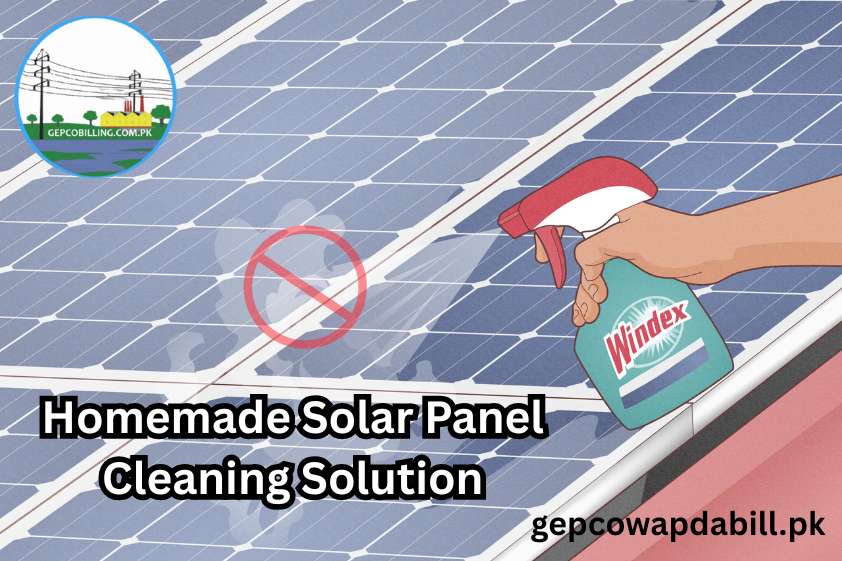
- Take about half a liter of water.
- Add 30–50 grams of laundry detergent (no need for fancy brands — even the inexpensive local ones will do the job).
- Mix in 100 ml of petrol.
- Add a bit of lemon juice or vinegar — lemon works best.
You can also add a pinch of baking soda and washing soda for extra cleaning power.
Best Cleaning Routine During Smog Season
Mix the solution well. Using a cloth or a shower spray, apply it evenly over your solar panels. Let it sit for a few minutes, then gently rub and rinse with clean water. You’ll notice an instant difference — the panels will look crystal clear, and the sticky smog film will be gone.
This homemade solution also creates a temporary protective layer, preventing new dust particles from sticking easily. For best results, first wash your panels with regular detergent and water, and then once with this special solution. This two-step process will keep your panels clean throughout the smog season.
It’s a cost-effective and highly practical method — a little effort and a few household ingredients can dramatically boost your solar panel efficiency during smoggy months.
Expected Power Drop and How to Minimize It
For instance, if your solar system normally generates 35–40 units a day in clear weather, keeping your panels clean with this method can help you maintain much higher production even in poor air conditions.
When the smog season sets in, the solar production drops sharply — from around 35–40 units a day down to just 15–20 units. The reason is obvious: smog blocks the sunlight, preventing it from reaching the panels properly. Besides that, during this time of year, daylight hours are shorter, which further reduces energy generation. Naturally, when sunlight can’t reach the panels effectively, their efficiency takes a nosedive.
Although electricity demand usually decreases in this season — since air conditioners are no longer in use and it’s neither too hot nor too cold to need heavy heating — you can still make the most of your solar setup. The best way is to keep your panels clean and maximize their efficiency. If you’re on a net metering system, the extra units you generate can be added to your GEPCO account and later used during the winter months for heating — or even carried forward to summer for air conditioning.
Maximizing Solar Efficiency Through Smart Energy Use
Another smart move is to shift some of your household energy use to electricity. During this season, gas shortages and load-shedding often leave domestic consumers with only two to four hours of gas supply per day. By switching to electric appliances, such as an induction cooker, you can manage most of your daily cooking — tea, curry, reheating food — everything except traditional bread (roti), which is a bit tricky on induction. This way, you’ll cut down on gas use and put your solar power to good use instead of letting it go to waste.
How Net Metering Helps You Balance Energy During Low-Production Months
Even if you don’t consume all your generated electricity, your extra units will keep accumulating in your GEPCO account through net metering. And if you continue to clean and maintain your solar panels properly, their output can rise again — maybe not all the way back to 35–40 units (since the sun stays out for fewer hours), but at least 25–30 units per day, which is still a decent improvement.
By following these steps, you’ll not only save energy today, but also store enough power for the future.
Benefits for a GEPCO Consumer
If you’re a GEPCO consumer using net metering and want to check your energy consumption, bill details, or remaining units, we’ve covered everything in a separate detailed article — you’ll find the link right here.
And if you ever need to generate a duplicate bill, check your new bill, or calculate your estimated units, simply visit our website. We’ve created dedicated pages and blogs for each of these topics — you’ll find everything under one roof, making it easy to resolve any billing-related issue without breaking a sweat.
For more information and to check your latest GEPCO electricity bill online, visit our GEPCO Bill Check page. You can also explore helpful guides such as GEPCO Online Bill Calculator and GEPCO Net Metering Guide. Blog page for latest post about gepco.


